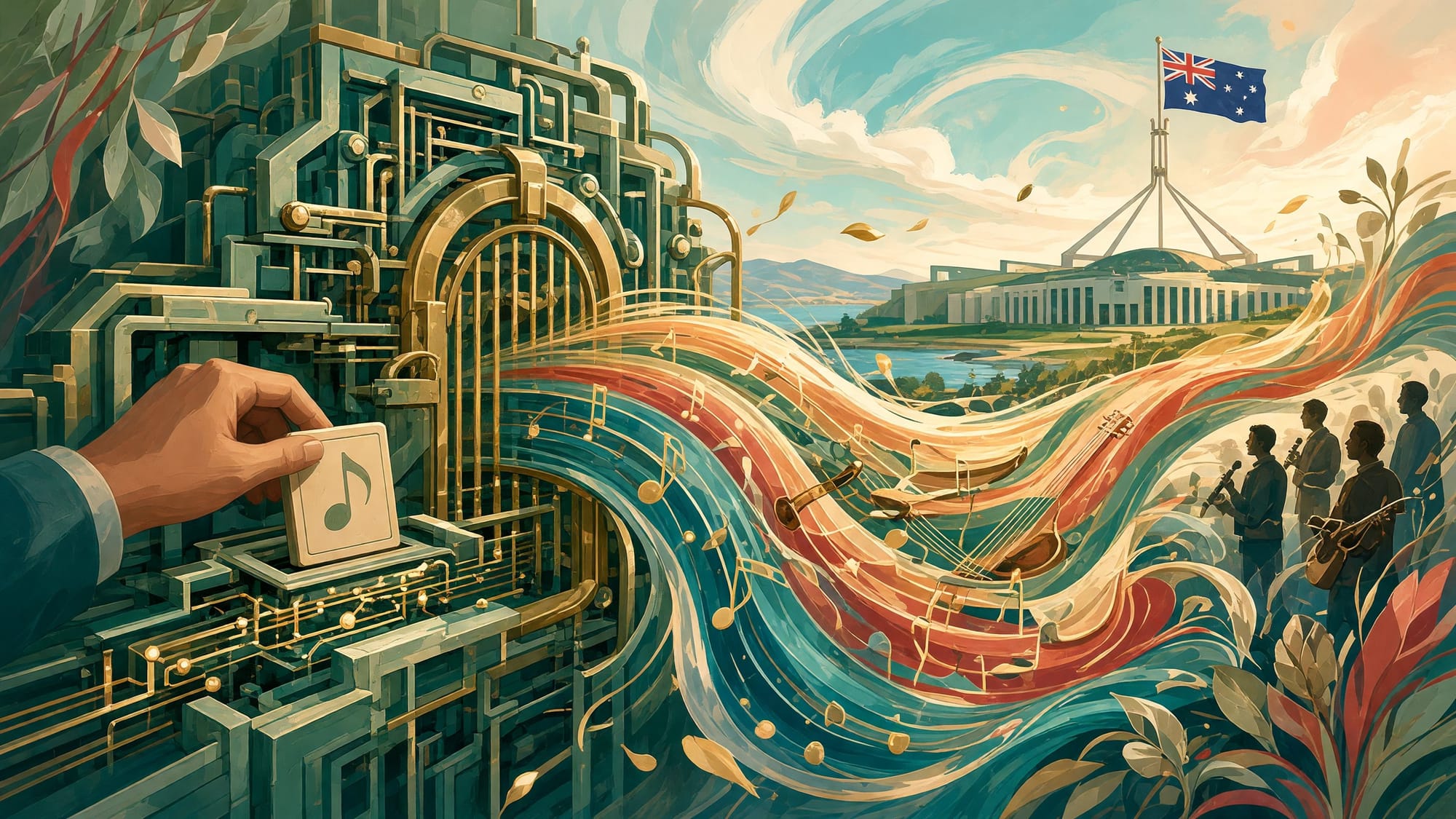
The Australian government is reportedly preparing to exempt music from a proposed artificial intelligence training licensing regime, attempting to defuse an escalating rebellion from the country’s creative sector.
As policymakers in Canberra race to finalise copyright reforms, their primary objective has been to lure major US artificial intelligence labs, such as OpenAI and Anthropic, to establish frontier training hubs in Australia. Under the framework currently being developed by the Albanese government, AI companies would be required to purchase a permit to legally train their models on Australian content.
However, The Australian Financial Review reports that music is now likely to be carved out from this blanket licensing regime. The policy shift follows intense lobbying from the local music industry, which has fiercely resisted any framework that would forcibly license their intellectual property to tech giants.
The industry's opposition reached a crescendo on Wednesday, 18 November 2026, during the ARIA Awards in Sydney. In a surprise pre-recorded address, Sir Elton John intervened in the domestic policy debate, explicitly backing the newly launched 'Not AI's to Take' initiative—a major copyright campaign recently mounted by a sweeping coalition of Australian creative workers.
"You have a duty to protect Australian artists and their work," John told the ARIA audience, directly addressing policymakers. "Don’t let AI use any Australian artist's work without full permission."
The proposed permitting system represents a bold attempt by the Australian government to solve the generative AI copyright impasse by monetising training data rather than blocking its use. Yet the music industry's apparent success in securing a carve-out creates a complicated precedent. If musicians are exempted from the mandatory licensing regime, other creative sectors—such as publishing, film and visual arts—are highly likely to demand equal protection, potentially unravelling the comprehensive data access that AI labs require to build frontier models.
For observers in Aotearoa New Zealand, Australia’s policy tightrope offers a critical test case. As the New Zealand government and other Asia-Pacific jurisdictions evaluate how to modernise copyright laws for the era of generative AI, the Australian experience highlights the profound difficulty of balancing the economic desire for sovereign AI infrastructure with the existential concerns of the creative workforce.
While the final legislative text is still being drafted, the government's willingness to amend its permit scheme underscores the growing political influence of the creative sector in the face of widespread AI disruption.
Sources
AI disclosure: Automated systems assisted with research and drafting. Gemini independently peer-reviewed this article before publication. Sources are linked for verification.