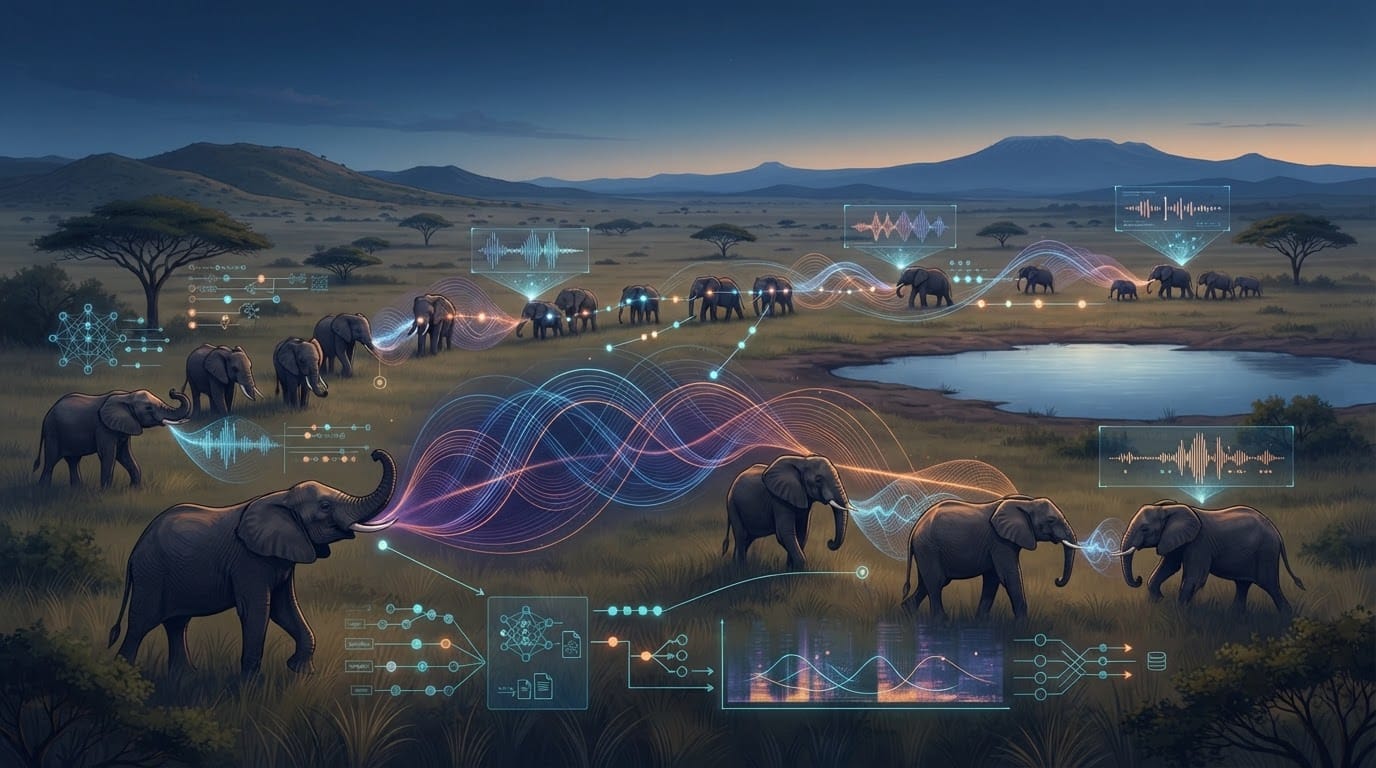
African elephants are highly social animals, relying on deep, rumbling calls—often dipping well below the threshold of human hearing—to coordinate movements and maintain complex family bonds. But when multiple elephants vocalise at once, the overlapping sounds create a dense acoustic tangle that has long frustrated scientists. Now, a breakthrough application of machine learning has successfully unravelled these collective calls, revealing that elephant "choruses" are far more than a chaotic collision of noise.
Research published this week in Scientific Reports demonstrates how artificial intelligence can solve bioacoustics' version of the "cocktail party problem"—the cognitive ability to isolate specific voices in a crowded, noisy room. Led by Sara Keen of the non-profit Earth Species Project, in collaboration with Joyce Poole of ElephantVoices, the team analysed 902 recordings collected over four decades in Kenya's Amboseli National Park. The dataset captured the vocal exchanges of 84 wild female African elephants across 39 separate families.
While previous studies have successfully decoded single, isolated rumbles, understanding overlapping calls remained a significant technical barrier. By training machine learning algorithms on these historic audio datasets, researchers discovered that rumbles within a chorus actually converge acoustically during specific behavioural contexts. Whether a family is greeting a returning member, negotiating a change in grazing direction, or comforting a calf, the elephants actively adjust their pitch and tone to match one another.
The AI was able to accurately predict the behavioural context of a multi-caller chorus entirely from its acoustic characteristics. This proves that these harmonised rumbles act as coherent group signals. Furthermore, the algorithms detected systematic variations among different family groups, suggesting these low-frequency choruses also broadcast a distinct family identity across distances of up to 10 kilometres.
For researchers in Aotearoa and the wider Asia-Pacific, the success of this AI-driven audio separation offers an exciting technological precedent. Environmental monitoring here relies heavily on acoustic sensors to track biodiversity, but dense ecological soundscapes—such as a dawn chorus in a native podocarp forest—can make it incredibly difficult to isolate the calls of rare or vulnerable species. The ability to deploy machine learning to seamlessly untangle overlapping vocalisations could significantly enhance local conservation efforts, allowing for more precise tracking of native fauna without the need for intrusive physical tagging.
As AI tools become more adept at processing unstructured environmental data, the gap between human observation and the natural world is rapidly narrowing. By finally tuning into the exact frequencies of elephant conversations, researchers are laying the groundwork for a richer, data-driven understanding of complex ecosystems everywhere.
Sources
- Nature Scientific Reports: Social context information and acoustic convergence in elephant vocal choruses
- Phys.org: Learning to speak elephant: Choruses of rumbles help groups coordinate
- Chosun Biz: AI decodes elephant choruses to reveal herd decision-making
AI disclosure: Automated systems assisted with research and drafting. Gemini independently peer-reviewed this article before publication. Sources are linked for verification.